Monday, 23 December 2013
PART 21: GETTING THINGS RIGHT
I’ve had quite an eventful time since I last blogged. I was offered a 2 book contract by Severn House and decided to commit myself to just one book, having already the idea for LOVE LETTERS IN THE SAND. I had to write a short synopsis which is something I hate doing but I managed it and now I'm glad I did because when I really get going after Christmas with it, I'll know pretty well the main events on the journey to the end of the book. Having come to an agreement with agent and publisher, I decided it was time for a break before Christmas.
Despite the dire weather forecast - rain, hail, gale force winds - John and I decided to nip up to the Lakes for a couple of days. This would be our Christmas present to each other. I’d recommend it. Especially as despite the weather we did manage to get a couple of walks in lovely Cumbria. Rydal Water was looking calm and beautiful with the reflection of the hills shining on the surface of the lake when we dumped our luggage at Highfield B&B in Ambleside. We visited the cave which must be known to thousands if not millions of walkers and mused with a couple of strangers over what must have been mined there. I presumed it was slate, only to be greeted with a shake of the head. I determined to google when I arrived home to find out the truth. As a writer I know just how important it is to get one’s facts right. If you get them wrong, there’s bound to be an eagle-eyed reader who will point out your mistake. I’ve never forgotten giving Runcorn a road bridge in 1952 when at the time cars were lifted over the River Mersey by transporter.
I’m pleased to say that I was right about what was mined at the cave. According to Google, Loughrigg Quarry, to give the cave its proper name, was quarried for good quality roofing slate and building stone for Ambleside and the surrounding area. We also got a bit wet the following day when John went for a fell run into Little Langdale from Elterwater and I did the walk to Skelwith waterfall. The rain was relentless but I kept hoping it would go off but it didn’t until after we were both back at the car.
Taken from the interior of Loughrigg Quarry by John Francis
Whilst away we made time to see the new Hobbit film - ‘The Desolation of Smaug’. I’d read THE HOBBIT to each of my three sons, as well as the sequel THE LORD OF THE RINGS. I’d also seen the three films several times. As well as the first of The Hobbit films, so naturally I was looking forward to seeing the latest one. I should have known not to take for granted it would be exactly true to the book. The special effects were fantastic and the two hours, forty-one minutes flew by. It’s true, though, that I whispered several times to my husband, ‘I don’t remember this happening in the book but I don’t mind a bit of budding romance really, but I’ll say no more. about that I hate spoilers! Besides I am aware that films and books require different treatments, otherwise there would be no need for screenwriters.
On our return home, I visited Formby Books to pick up a book by Jacqueline Winspear. It was one of the Maisie Dobbs detective crime series called A LESSON IN SECRETS. This one is set in Cambridge in 1932 and I’m really looking forward to reading it, once I’ve finished an ex-library book by Ann Grainger, who used to write historical romance for Masquerade at the same time I did. This book is a detective one, too, A MORTAL CURIOSITY but set in Victorian times and is the second in the Lizzy Martin series.
Whilst in Formby I met Sean Connelly promoting his latest book. Ex-army naturally he writes about his experiences as a soldier. At least I’m taking for granted that’s his subject matter. Apparently he’s also a rapper and was raising funds for Help For Heroes in Formby.
I got things wrong in my last blog called FAMILY TIES when writing about the Gregory family. Due to misreading about about my Great-great Aunt Lavinia Gregory in the censuses, on Ancestry. I presumed that she had married the master of the house where she was a cook. The man she really wed was Thomas Williams, a widower with children. Her story wasn’t one that some might call a Rags to Riches, a bit like a Mills & Boon romance where the heroine marries her boss. Instead Thomas was a plumber, lodging in a large house on the Wirral. After their marriage, they lived in a two up, two down. Lavinia gave birth to seven children while living there, but then William went on to become an acetylene engineer and made enough money for them to afford to move to that large house, near Bebington in the photograph. It was there Lavinia gave birth to another four children. I think she belongs to my list of women in the family who were tough cookies. One of the children born in that two up, two down, was the mother of Laura (Pat) Holt, who emailed me the photos and she is the lovely bride,Hilda Mary Magdeline Williams and her handsome bridegroom was James Francis Edward Murphy. My apologies to that branch of my extended family.
Thursday, 12 December 2013
TIS THE SEASON TO BE JOLLY and PART 20: FAMILY TIES
‘TIS THE SEASON TO BE JOLLY
It’s more than a week since I’ve blogged and that’s down to Advent and there being so much to think about and do before Christmas.
It started with the Christmas Ladies Brunch at Caradoc Mission, Seaforth, with lovely decorated tables, a buffet, lots of chat with my cousin Patsy, her daughter, Colette and friends, as well as jokes, a Christmas message and cupcakes and mince pies served at table.
On Thursday we had a Christmas social evening at Crosby Writers Club which was fun; Christmas readings, two quizzes and refreshments, including lovely mince pies baked by member, Joyce, to her special recipe. I read out my very first acceptance which was an article on Christmas Customs Around the World in 1983. I was paid a whole £25!
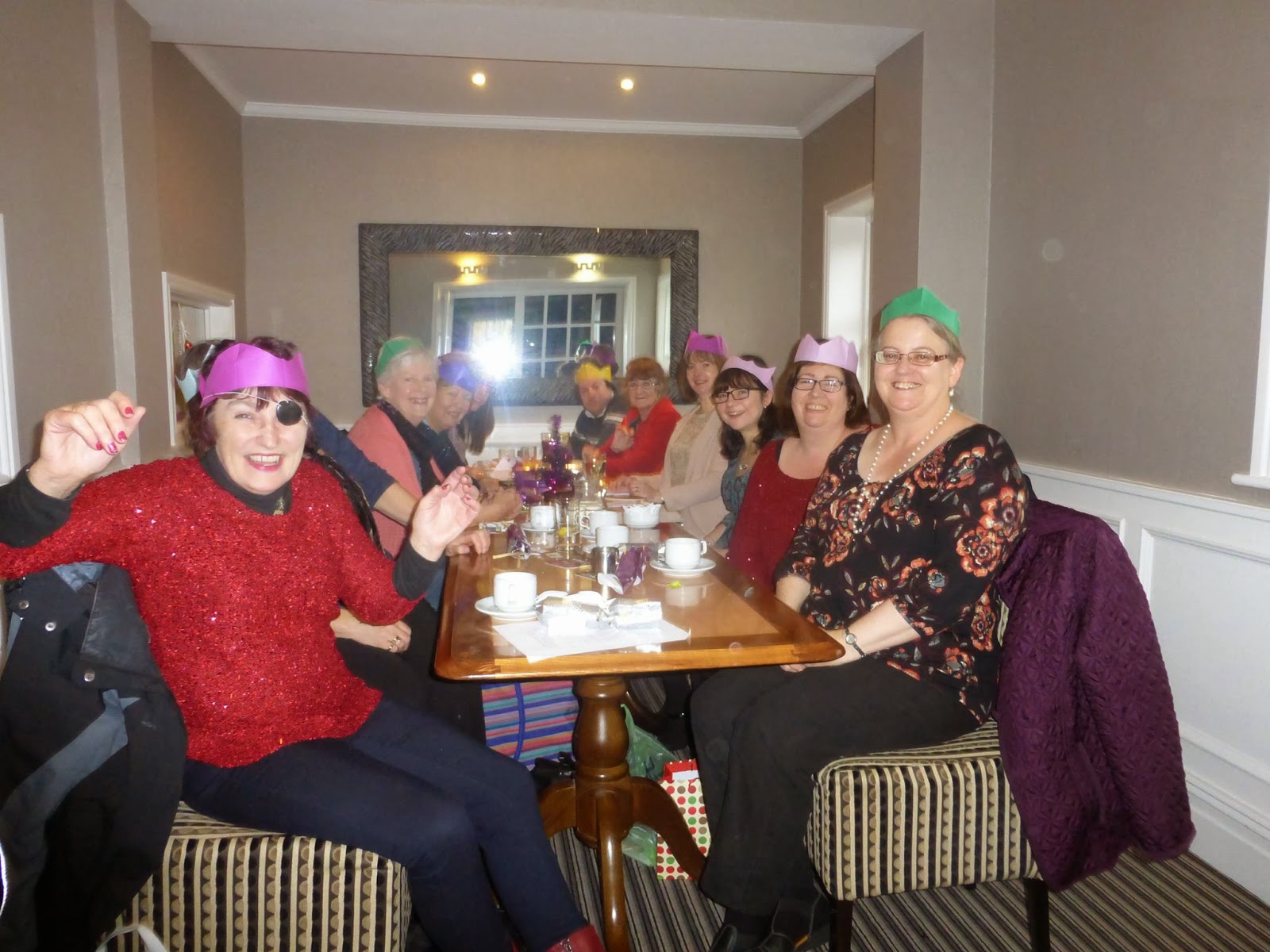
Then on the Friday there was the Novelistas Christmas lunch at the Bod Erw, St Asaph, with an exchange of writing news, a raffle in which everyone got a prize, and Christmas cake baked by Juliet Greenwood to her mother’s recipe which included the most tasty toasted almonds.
The Novelistas celebrating Christmas at Bod Erw, St Asaph.
When Saturday arrived it was St Paul’s church’s Christmas Fayre. I was in charge of the second-hand bookstall which is always interesting. Crime is always popular as are sagas. I picked up a copy of Maeve Binchy’s SCARLET FEATHER. But my favourite stall was the homemade cake stall. There were more lovely homemade mince pies, cup cakes and my friend Elsie’s bun loaf which was absolutely scrumptious. People chattered and worked together and it seemed to me that a good time was had by all and we raised a decent sum for the church. (The cost of heating is horrendous).
You might be getting the impression from what I’ve written so far that all I have on my mind is food. With four hungry males in the house that has some basis in face because I’m already planning what to eat for Christmas Eve, Christmas Day, New Year’s Eve and Day.
But on Saturday evening John and I attended a performance of Handel’s “Messiah” performed at Liverpool’s Anglican Cathedral by choirs from both Liverpool Cathedrals, accompanied by the Anglican Cathedral Chamber Orchestra. It was an experience not to be missed and was food for the soul. There was well over a thousand people in the audience and the performance was a real treat.
For lots of people Christmas is a time for family, although there are those who would do anything rather than spend time with their family. Too much pressure perhaps to play at happy families when the lead up to the day has been exhausting. I’m sure it was never meant to be like that and maybe it’s due to people seeing it only as a time for children and presents. Both can be a blessing but when expectations are too high, disappointment can follow. One of my sons has already said that he’s not doing presents this year and doesn’t want any either. He wouldn’t be the first. John and I decided a while ago not to give each other presents but settled on spending the money on two nights away in the Lake District before or after the Big Day. I can’t wait!
PART 20: FAMILY TIES
Despite what I said in my last blog about families and Christmas, my mother reared us in the belief that families should stick together. No doubt she saw the importance of doing so because her mother, Flora, died when Mam was only ten years old. Her aunts stepped into the breach to care for her and her siblings while her mariner father was at sea.
My parents, Stanley Nelson and May Lillian Milburn, married during the Depression in the Thirties and money was short. I remember Mam telling me how good my father’s mother, Ada Florence Nelson, nee Cooke, was to them, giving them tea and sugar and other food to help them out.
Since researching my ancestry, I know now that my grandmother Nelson, she also suffered the loss of her mother, Mary Ellen Gregory, at the same age as my mother did; although Mary Ellen was only thirty-one when she died and Mam’s mother was forty. Mary Ellen left a five year old daughter, Emma, as well as my ten year old grandmother.
Mary Ellen was born in Liverpool in 1854 and at seventeen was working as a general servant in Park Street, a long thoroughfare that ran from the docks up to Park Lane, a rather posh area of large houses in Toxteth in Victorian times. My mother also worked in service for a doctor and his family but that was in the 1920-30s.
Mary Ellen’s father, Stanley Gregory, was born in Aughton Street, Ormskirk, in 1821. But by 1845 he was living in Liverpool and that year he married Eleanor Nicholson from Anglesey, in the Church of our Lady, St Nicholas and St Anne. A bricklayer by trade, no doubt he had come to Liverpool like many another in search of work.
Stanley was one of fourteen children, including two sets of twins,(interestingly two of my Nelson cousins, Patsy and Audrey, gave birth to twins). His father, John, was also a bricklayer.
The Gregorys can be traced back to the reign of Queen Anne in the early 18th century living in the Ormskirk area. John had married a Moorcroft, as had his father, Robert, and there are several graves with the names of Moorcroft and Gregory to be found in the graveyard of Ormskirk ancient parish church, which is well worth a visit. The church is famous for having a spire and a tower and is open during the summer on market day.

Ormskirk parish church in Lancashire: Photographer John Francis
Eleanor, whose mother was an Owen, was still living in Holyhead in 1841, so must have come to Liverpool between then and 1845. Her father, Jared, was a dock-gate man in Holyhead, so maybe one of his relatives was a mariner and married a woman from Liverpool and Eleanor visited them and that’s how she met Stanley. She had a couple of brothers and two sisters still living on the beautiful island of Anglesey.
My son Tim fishing at Trearddur Bay, Anglesey
Photographer: John Francis
Anglesey coastline with South Stack lighthouse in the distance.
By 1851 Stanley and Eleanor were living in Clive Street, Toxteth Park. She was to die four years after her daughter, Mary Ellen’s marriage to James Cooke, the year my grandmother Ada Florence was born, but Stanley lived into the 1880s. So my grandmother must have known her grandfather, Stanley Gregory, and possibly some of her Welsh aunts and uncles, too. I always wondered why my dad was called Stanley and now I know.
It was whilst tracing the various Gregorys that two distant members of the Gregory family got in touch with me. I was interested in particular in Lavinia Gregory, who was the sister of my great-grandmother, Mary Ellen, being thirteen years younger.
I found Lavinia in the 1891 census living the other side of the Mersey in Birkenhead. She was a maid but later became a housekeeper and was to marry the master of the house. Although they married at a church in Toxteth, they settled on the Wirral. He already had children but Lavinia was also to provide him with more offspring.
My Great-great-aunt Lavinia's family home on the Wirral
Family wedding at the house in the thirties. Lavinia is second left at the front.
Laura Holt (known as Pat) who emailed me the above photos got in touch with me from Australia. She is Lavinia’s granddaughter. Her mother and my grandmother, Ada Florence were first cousins. Lavinia did well for herself, brought up in a terraced house in Toxteth, went into service, eventually becoming a housekeeper and then the mistress of a large house, near Bromborough. Born in 1867, she lost her mother at the age of 9, but lived to the ripe old age of 85, dying in 1952, having seen the advent of the steamship, the motor car, the opening of the Mersey Tunnel and lived through two world wars.
It’s more than a week since I’ve blogged and that’s down to Advent and there being so much to think about and do before Christmas.
It started with the Christmas Ladies Brunch at Caradoc Mission, Seaforth, with lovely decorated tables, a buffet, lots of chat with my cousin Patsy, her daughter, Colette and friends, as well as jokes, a Christmas message and cupcakes and mince pies served at table.
On Thursday we had a Christmas social evening at Crosby Writers Club which was fun; Christmas readings, two quizzes and refreshments, including lovely mince pies baked by member, Joyce, to her special recipe. I read out my very first acceptance which was an article on Christmas Customs Around the World in 1983. I was paid a whole £25!
Then on the Friday there was the Novelistas Christmas lunch at the Bod Erw, St Asaph, with an exchange of writing news, a raffle in which everyone got a prize, and Christmas cake baked by Juliet Greenwood to her mother’s recipe which included the most tasty toasted almonds.
The Novelistas celebrating Christmas at Bod Erw, St Asaph.
When Saturday arrived it was St Paul’s church’s Christmas Fayre. I was in charge of the second-hand bookstall which is always interesting. Crime is always popular as are sagas. I picked up a copy of Maeve Binchy’s SCARLET FEATHER. But my favourite stall was the homemade cake stall. There were more lovely homemade mince pies, cup cakes and my friend Elsie’s bun loaf which was absolutely scrumptious. People chattered and worked together and it seemed to me that a good time was had by all and we raised a decent sum for the church. (The cost of heating is horrendous).
You might be getting the impression from what I’ve written so far that all I have on my mind is food. With four hungry males in the house that has some basis in face because I’m already planning what to eat for Christmas Eve, Christmas Day, New Year’s Eve and Day.
But on Saturday evening John and I attended a performance of Handel’s “Messiah” performed at Liverpool’s Anglican Cathedral by choirs from both Liverpool Cathedrals, accompanied by the Anglican Cathedral Chamber Orchestra. It was an experience not to be missed and was food for the soul. There was well over a thousand people in the audience and the performance was a real treat.
For lots of people Christmas is a time for family, although there are those who would do anything rather than spend time with their family. Too much pressure perhaps to play at happy families when the lead up to the day has been exhausting. I’m sure it was never meant to be like that and maybe it’s due to people seeing it only as a time for children and presents. Both can be a blessing but when expectations are too high, disappointment can follow. One of my sons has already said that he’s not doing presents this year and doesn’t want any either. He wouldn’t be the first. John and I decided a while ago not to give each other presents but settled on spending the money on two nights away in the Lake District before or after the Big Day. I can’t wait!
PART 20: FAMILY TIES
Despite what I said in my last blog about families and Christmas, my mother reared us in the belief that families should stick together. No doubt she saw the importance of doing so because her mother, Flora, died when Mam was only ten years old. Her aunts stepped into the breach to care for her and her siblings while her mariner father was at sea.
My parents, Stanley Nelson and May Lillian Milburn, married during the Depression in the Thirties and money was short. I remember Mam telling me how good my father’s mother, Ada Florence Nelson, nee Cooke, was to them, giving them tea and sugar and other food to help them out.
Since researching my ancestry, I know now that my grandmother Nelson, she also suffered the loss of her mother, Mary Ellen Gregory, at the same age as my mother did; although Mary Ellen was only thirty-one when she died and Mam’s mother was forty. Mary Ellen left a five year old daughter, Emma, as well as my ten year old grandmother.
Mary Ellen was born in Liverpool in 1854 and at seventeen was working as a general servant in Park Street, a long thoroughfare that ran from the docks up to Park Lane, a rather posh area of large houses in Toxteth in Victorian times. My mother also worked in service for a doctor and his family but that was in the 1920-30s.
Mary Ellen’s father, Stanley Gregory, was born in Aughton Street, Ormskirk, in 1821. But by 1845 he was living in Liverpool and that year he married Eleanor Nicholson from Anglesey, in the Church of our Lady, St Nicholas and St Anne. A bricklayer by trade, no doubt he had come to Liverpool like many another in search of work.
Stanley was one of fourteen children, including two sets of twins,(interestingly two of my Nelson cousins, Patsy and Audrey, gave birth to twins). His father, John, was also a bricklayer.
The Gregorys can be traced back to the reign of Queen Anne in the early 18th century living in the Ormskirk area. John had married a Moorcroft, as had his father, Robert, and there are several graves with the names of Moorcroft and Gregory to be found in the graveyard of Ormskirk ancient parish church, which is well worth a visit. The church is famous for having a spire and a tower and is open during the summer on market day.
Ormskirk parish church in Lancashire: Photographer John Francis
Eleanor, whose mother was an Owen, was still living in Holyhead in 1841, so must have come to Liverpool between then and 1845. Her father, Jared, was a dock-gate man in Holyhead, so maybe one of his relatives was a mariner and married a woman from Liverpool and Eleanor visited them and that’s how she met Stanley. She had a couple of brothers and two sisters still living on the beautiful island of Anglesey.
My son Tim fishing at Trearddur Bay, Anglesey
Photographer: John Francis
Anglesey coastline with South Stack lighthouse in the distance.
By 1851 Stanley and Eleanor were living in Clive Street, Toxteth Park. She was to die four years after her daughter, Mary Ellen’s marriage to James Cooke, the year my grandmother Ada Florence was born, but Stanley lived into the 1880s. So my grandmother must have known her grandfather, Stanley Gregory, and possibly some of her Welsh aunts and uncles, too. I always wondered why my dad was called Stanley and now I know.
It was whilst tracing the various Gregorys that two distant members of the Gregory family got in touch with me. I was interested in particular in Lavinia Gregory, who was the sister of my great-grandmother, Mary Ellen, being thirteen years younger.
I found Lavinia in the 1891 census living the other side of the Mersey in Birkenhead. She was a maid but later became a housekeeper and was to marry the master of the house. Although they married at a church in Toxteth, they settled on the Wirral. He already had children but Lavinia was also to provide him with more offspring.
My Great-great-aunt Lavinia's family home on the Wirral
Family wedding at the house in the thirties. Lavinia is second left at the front.
Laura Holt (known as Pat) who emailed me the above photos got in touch with me from Australia. She is Lavinia’s granddaughter. Her mother and my grandmother, Ada Florence were first cousins. Lavinia did well for herself, brought up in a terraced house in Toxteth, went into service, eventually becoming a housekeeper and then the mistress of a large house, near Bromborough. Born in 1867, she lost her mother at the age of 9, but lived to the ripe old age of 85, dying in 1952, having seen the advent of the steamship, the motor car, the opening of the Mersey Tunnel and lived through two world wars.
Tuesday, 3 December 2013
PART 19: MORE ASPECTS OF MY WRITER'S LIFE
Sunset over the Sandhills at Freshfield, nr Formby on the Lancashire coast: Photographer: Timothy Francis.
I did a talk recently for the Birkdale University of the 3rd Age Group. They were a friendly bunch, as well as attentive. One of the questions I was asked was “D’you ever get writer’s block?”
It’s a question that has come up before and I can honestly reply that it is something that never bothers me these days; in as much that if I reach a place where I’m not sure where to go next, I either just type any old rubbish that comes into my head (brainstorming some call it) or I go for a walk, knowing that sooner or later my subconscious will come up with what will happen next.
I was also asked by someone else whether I always worked everything out before I got started. Obviously not! I was also asked did I know how the book is going to end. I could honestly answer that with “I have a vague idea” with the proviso that sometimes the characters themselves alter the ending I might have had in mind.
June (me) and the chairman of Birkdale U3A: Photographer: Fred McCann.
It is essential, though, to get ideas down as they pop into my mind. Once I used to just carry them in my head but the older I get the easier it is to forget a brilliant plot development; although my son, Tim, says that forgetfulness isn’t just an age thing and that he often forgets things too and it’s best to write stuff down.
Computer best to make notes but I find a calendar with lovely pictures and space enough to scribble in messages to myself hung on the wall in front of my desk is ideal for remembering talks and events. Diaries I’m inclined to put in a drawer and forget about. I already have next year's calendar that has photographs of lovely Lancashire which I bought in Waterstone’s bookshop in Southport when I was there for the Christmas lunch of the Romantic Novelist Association’s Northwest Chapter.
There were about 27 of us and I was seated by Katy Flynn and Anne Baker, who both write Liverpool based sagas and are very successful. It was good to discuss the changes in publishing and the writing life with them. The writer on my right hand side was Lynne Connelly who is an author of historical, erotic and fantasy romance, mainly for the American market in e-book format. It is a market of which she is very knowledgeable. She is also a lover of gadgets and had one to show us. I am not a techie at all but she was so enthusiastic about her latest buy which apparently is ideal for an author who hops across the Pond at least once a year. She is very aware of the importance of keeping in touch with her American market by attending the RWA Conference in the USA. Those who have been in the business for years, like myself, need the younger ones like Lynn Connelly and Annie Burrows who writes Regency romance for Harlequin Mills & Boon.
When I first joined the RNA there were no Chapters, only the meetings in London for its members. The idea of chapters was broached at the very first RNA conference in 1998 at Stoneyhurst College, Lancashire. Freda Lightfoot and I were the first to get involved in setting up the chapter in Northwest England.
Interestingly Stoneyhurst College has literary connections of another kind. Former pupil, Sir Arthur Conan Doyle, creator of Sherlock Holmes, based Baskerville Hall on Stoneyhurst Hall and Moriarty was apparently named after a fellow pupil of Conan Doyle. Also J.R.R. Tolkein wrote part of THE LORD OF THE RINGS while staying at the college where his son taught Classics.
It had also been arranged that some of us visited Magna Large Print Books in Long Preston whilst at Stoneyhurst. We met the lovely Diane Allan, who is in charge there and who is now a writer, herself. If my memory serves me right, not only were we shown the whole process of how our books were turned into Large Print but we were served a lovely lunch as well. Magna also produce Audio.
I had seldom visited the beautiful Lancashire countryside until my husband, John, took up fell running and introduced me to such places as Downham, Belmont, Pendle, Rivington Pike and Parbold Hill. Writers do really need to take time out from the writing and I now regard Lancashire as not only a country where I find inspiration for my books but also it was great discovering that some of my ancestors, the Gregorys and Morecrofts came from the lovely market town of Ormskirk but more of them next time.
Below is a lovely snowy scene of Pendle Hill in the distance taken from the village of Downham. Photographer: John Francis.
Saturday, 23 November 2013
PART 18: FROM HERE TO THERE AND BACK AGAIN (2)
For those who might find reading about my ancestry and its connection with the social history of the period not of interest, you can either look away now or just skim read in case you find some fascinating nuggets of information!
Following my trip to London, I took out my Milburn file and worked out that my great-great grandfather, James Percival and his wife Elizabeth, nee Walker, must have come to Liverpool from Manchester, quite soon after they were married. In 1851, they were living in Albert Terrace, near Smithdown Road where Toxteth cemetery is situated. So some distance from the docks but being a smith, no doubt James would have been able to find work in the bustling port. Within ten years they had moved across town and were living in Athol Street, off Scotland Road, and had six children, including my great-grandmother Jane. They were to have another three children, including Ken Fraser’s grandfather, Edward Percival, nine years younger than my great-grandmother.
Why had they moved from Manchester to Liverpool? Especially at a time when the Irish had flooded into Liverpool due to the Great Famine caused by a fungus destroying the potato crop. Surely there should have been work for James as a smith? Besides they had family there. His father, John was a bricklayer, so one imagines that was a reasonably safe job in the prosperous city of Manchester. too. As for Elizabeth’s father, William Walker, he had been born in Ireland in 1791, but had moved to England well before the famine and married a Manchester girl. He was a weaver by trade and in 1841 was living in Manchester, although by the time of his daughter’s wedding in 1849, he was working as a watchman and had moved house.
I googled Manchester and after reading various sites came to the conclusion that William was most likely dead within a couple of years of the wedding because I can’t find any trace of him in the 1851 census. I reckon he could have suffered from “Mill Fever” which consisted of aching head, limbs, nausea, caused by the dust and cotton lint in the air, which could lead to asthma, bronchitis or TB. The average life expectancy for a male worker in Manchester at one time was as short as seventeen years of age. William was fortunate to live into his fifties.
I’ve come to the conclusion that despite Liverpool having terrible poverty, housing and sanitary conditions, it was actually a healthier and pleasanter place to live, due to its situation besides the Mersey and its closeness to the sea, as well as its lack of mills belching out smoke and polluting the air. (I have found a site which I think is brilliant as it describes several walks through Liverpool taken from a guide published 1843)
http://www.old-liverpool.co.uk/walk1843.html
The population of the two towns had quadrupled during the first half of the 19th century, mainly due to both having a high influx of Irish but due to its importance as a port, but Liverpool was to lead the way and be the first in several fields to improves the lot of its citizens.
Having visited Ireland several times I’ve always insisted that I have no Irish blood when asked but the Irish shook their heads and said, ‘If you’re a Liverpudlian, you’ll have Irish blood in you somewhere.’
I find it strange that I should have traced my Irish ancestry to Manchester first. Unfortunately I had difficulty discovering exactly where in Ireland my 3xtimes great grandfather came from as there are absolutely numerous William Walkers who were weavers in the Irish records. Anyway, I decided yesterday to google William Walker, weaver. This led me to a several sites and one informed me that Walker was an anglicised form of the Gaelic Nucator, found in Ulster and going back to Morayshire in Scotland. Most likely it originally derived from the name Mac-An- Fhuca-dair meaning Son of the Cloth Fuller. It makes sense to me because fullers had an important role in the cloth trade! And there’s me thinking I had no Scottish blood as well as no Irish!
I am reminded of the research I did for my Harlequin M& B book, PIRATE’S DAUGHTER, REBEL WIFE, set during the 16th century. It was a time when certain Irish clans called on the support of their Scottish kinsmen when they went to warring with each other. It's already available on Amazon but is to be published in French translation on 1st December 2013 under the title of: LES AMANTS DE MADERE.

This to-ing and fro-ing of population going from here to there and back again has always taken place in the British Isles and elsewhere. But the link between Scotland and Northern Ireland and Liverpool has always been strong. My husband’s mother, always believed that the father she never knew came from Greenock, Scotland. My search for David Frizzell certainly led me to Scotland but it turned out that he had been born in Antrim, Northern Ireland. He lived in Greenock for several years, working as a labourer in a sugar factory and after being widowed, I presume he came south by ship, because for a short period he was a mariner. Then he got a job working in Tate’s sugar refinery in Liverpool as a labourer and continued in that job, marrying Liverpool girls twice and being widowed twice in a very sort time. His second wife died shortly after my mother-in-law’s birth and she was fostered by a Scotsman and his Liverpudlian wife.
My mother-in-law voiced an opinion that Frizzell sounded Italian but it turned out to be Gaelic for Fraser. There is more interesting stuff about the origin of the name Frizzell that can be spelt in several ways that date back to Henry II and the Earl of Pembroke’s followers who went over to Ireland in the 12th century and that the name is of French origin.
But I think that is enough for now.
Following my trip to London, I took out my Milburn file and worked out that my great-great grandfather, James Percival and his wife Elizabeth, nee Walker, must have come to Liverpool from Manchester, quite soon after they were married. In 1851, they were living in Albert Terrace, near Smithdown Road where Toxteth cemetery is situated. So some distance from the docks but being a smith, no doubt James would have been able to find work in the bustling port. Within ten years they had moved across town and were living in Athol Street, off Scotland Road, and had six children, including my great-grandmother Jane. They were to have another three children, including Ken Fraser’s grandfather, Edward Percival, nine years younger than my great-grandmother.
Why had they moved from Manchester to Liverpool? Especially at a time when the Irish had flooded into Liverpool due to the Great Famine caused by a fungus destroying the potato crop. Surely there should have been work for James as a smith? Besides they had family there. His father, John was a bricklayer, so one imagines that was a reasonably safe job in the prosperous city of Manchester. too. As for Elizabeth’s father, William Walker, he had been born in Ireland in 1791, but had moved to England well before the famine and married a Manchester girl. He was a weaver by trade and in 1841 was living in Manchester, although by the time of his daughter’s wedding in 1849, he was working as a watchman and had moved house.
I googled Manchester and after reading various sites came to the conclusion that William was most likely dead within a couple of years of the wedding because I can’t find any trace of him in the 1851 census. I reckon he could have suffered from “Mill Fever” which consisted of aching head, limbs, nausea, caused by the dust and cotton lint in the air, which could lead to asthma, bronchitis or TB. The average life expectancy for a male worker in Manchester at one time was as short as seventeen years of age. William was fortunate to live into his fifties.
I’ve come to the conclusion that despite Liverpool having terrible poverty, housing and sanitary conditions, it was actually a healthier and pleasanter place to live, due to its situation besides the Mersey and its closeness to the sea, as well as its lack of mills belching out smoke and polluting the air. (I have found a site which I think is brilliant as it describes several walks through Liverpool taken from a guide published 1843)
http://www.old-liverpool.co.uk/walk1843.html
The population of the two towns had quadrupled during the first half of the 19th century, mainly due to both having a high influx of Irish but due to its importance as a port, but Liverpool was to lead the way and be the first in several fields to improves the lot of its citizens.
Having visited Ireland several times I’ve always insisted that I have no Irish blood when asked but the Irish shook their heads and said, ‘If you’re a Liverpudlian, you’ll have Irish blood in you somewhere.’
I find it strange that I should have traced my Irish ancestry to Manchester first. Unfortunately I had difficulty discovering exactly where in Ireland my 3xtimes great grandfather came from as there are absolutely numerous William Walkers who were weavers in the Irish records. Anyway, I decided yesterday to google William Walker, weaver. This led me to a several sites and one informed me that Walker was an anglicised form of the Gaelic Nucator, found in Ulster and going back to Morayshire in Scotland. Most likely it originally derived from the name Mac-An- Fhuca-dair meaning Son of the Cloth Fuller. It makes sense to me because fullers had an important role in the cloth trade! And there’s me thinking I had no Scottish blood as well as no Irish!
I am reminded of the research I did for my Harlequin M& B book, PIRATE’S DAUGHTER, REBEL WIFE, set during the 16th century. It was a time when certain Irish clans called on the support of their Scottish kinsmen when they went to warring with each other. It's already available on Amazon but is to be published in French translation on 1st December 2013 under the title of: LES AMANTS DE MADERE.

This to-ing and fro-ing of population going from here to there and back again has always taken place in the British Isles and elsewhere. But the link between Scotland and Northern Ireland and Liverpool has always been strong. My husband’s mother, always believed that the father she never knew came from Greenock, Scotland. My search for David Frizzell certainly led me to Scotland but it turned out that he had been born in Antrim, Northern Ireland. He lived in Greenock for several years, working as a labourer in a sugar factory and after being widowed, I presume he came south by ship, because for a short period he was a mariner. Then he got a job working in Tate’s sugar refinery in Liverpool as a labourer and continued in that job, marrying Liverpool girls twice and being widowed twice in a very sort time. His second wife died shortly after my mother-in-law’s birth and she was fostered by a Scotsman and his Liverpudlian wife.
My mother-in-law voiced an opinion that Frizzell sounded Italian but it turned out to be Gaelic for Fraser. There is more interesting stuff about the origin of the name Frizzell that can be spelt in several ways that date back to Henry II and the Earl of Pembroke’s followers who went over to Ireland in the 12th century and that the name is of French origin.
But I think that is enough for now.
PART 17: FROM HERE TO THERE AND BACK AGAIN (1)
Eros, Piccadilly Circus, seen through a Bubble:
Photographer: Ken Fraser
Despite it being a rainy Wednesday in November, London was heaving when I arrived after a comfortable journey, via Virgin trains. It was good to get away, having checked over the proofs of IT’S NOW OR NEVER and done a talk for the Old Roan, Town Women’s Guild earlier in the week. I was in the capital for the RNA Winter Party, where I planned to see not only my agent and editors but some writer friends, such as Linda Sole, whom I hadn’t seen for a couple of years. As well as that I had arranged to meet Ken Fraser, who had contacted me through Ancestry after discovering we both might be descended from James Percival, a smith from Manchester, who after marrying Elizabeth Walker in the parish cathedral church in 1849, moved to Liverpool. (More of the Percivals and Walkers in next blog).
I was early for the party and the meeting with Ken, so I visited the Australian art exhibition at the Royal Academy, Piccadilly. I was there for over two hours and learnt more than I had reckoned on. Not only about Australian and British artists and history but I never realised that German, Swiss and French artists also visited Australasia as far back as the early 1800s.
I got chatting with two ladies, one thought I might be Australian but I told her, no, a Liverpudlian. She told me in a lovely Scottish accent that she had been to Liverpool and had lived in Australia for a while. She had moved back to Glasgow several years ago and was of the opinion I should visit Australia one day. I didn’t like saying that the thought of being in a plane that long filled me with dread. Four hours of flying to the Greek island of Rhodes was enough for me.
The other younger woman lived in Wiltshire but knew Liverpool because she had spent time with her partner living on the Wirral, his having been commission to do a work of artistic merit in Birkenhead across the Mersey.
Mention of the Mersey made me think of the thousands of emigrants who had departed for Australian shores from Liverpool. I was reminded of Captain Cook, a replica of whose ship Endeavour can be seen in Whitby, and also of my sailor grandfather John Jones Milburn whom Mam told us had been deported from Australia for getting involved in a knife fight over a girl when he was 19. My cousin, George Milburn, had never heard the tale, so was there any truth in the story? But Mam had also told me that a Milburn relative had worked for the Australian post office company way back.
I had discovered from Ancestry that after leaving Liverpool, at the age of nine, Granddad was living in Bromley, St Leonards, in the Poplar borough, here the extremely successful SEND FOR THE MIDWIFE was to be set years later. And according to the 1901 census, he was working in an ironworks in West Ham at the age of 29. Interestingly I can’t find Granddad on the 1991 census, so possibly there is a germ of truth in Mam’s story. I’m just glad that he returned to Liverpool and married my grandmother Flora Brookes in 1902 or I wouldn’t be writing this. It had come as something of a surprise to me that his mother had given birth to another six children after the move to London. Several of their descendents have been in touch with me since and I’ve heard some family tales that are just as fascinating as the one Mam told me.
Ken Fraser and I in the Royal Academy Restaurant
Anyway, back to the present and that meeting with my Percival related cousin, Ken Fraser. Despite this being my first meeting with Ken, we had exchanged emails and I knew that he had moved south, after having completed his National Service, he had gone to RADA where he met Judi Dench and Vanessa Redgrave and lived the actor’s life for a while. Later he be came a book seller but was now retired. We had discovered we had mutual acquaintances in the world of publishing and he was accompanied by editor and erstwhile publisher, Sue Curran. We sojourned to the Royal Academy restaurant for a cream tea and cuppa in my case and Sue’s, while Ken had a latte. He had brought along some photos of the Percival girls. The one I liked in particular is shown below and is of his mother and her six sisters and we had a good natter about the family tree and publishing.
Back row from left: Ann, the eldest, whose naval husband was killed in WW2 but whose son survived the war, next Alice, then Ivy, who was a Sister at Salford Royal Hospital and received the MBE for services to nursing. Front row: Sitting, holding book, Ken's mother, Olive, then Eva, who married and had 3 boys, next Edith married and one boy and finally Beattie, married and one boy and one girl. Most likely the picture was taken in the late 1920s and the Percival sisters were my grandmother, Flora Milburn, nee Brookes, cousins. Their father, Edward, being Flora's mother, Jane's younger brother.
Later at the winter party I met up with my agent, editors, and good friends old and newish, including writer Freda Lightfoot and her husband, who had flown over from Spain for the event, www.fredalightfoot.co.uk and Novelista members, Trisha Ashley and Anne Bennett. https://www.facebook.com/pages/Novelistas-Ink/406487762781396 . When you get so many people together, mainly women, the noise level is terrific and you can hardly hear yourself speak, never mind anyone else. Still, it was enjoyable getting away from the house and the computer. Then it was back to Liverpool with my mind buzzing with the conversations I’d enjoyed and all that I had seen.
Saturday, 16 November 2013
PART 16:CAUSE AND EFFECT
It’s my birthday this month and there’s times when it’s grieved me that I wasn’t born in Liverpool. The blame can be laid at the door of the Luftwaffe for having bombed Mill Road hospital, so Mam was evacuated and I was born in Blackpool. I have thought since tracing my ancestry that my being born in Blackpool could have baffled anyone looking for me. Mam returned home to Liverpool after the birth to be reunited with my brothers as Dad was away in the army. Most likely they were being looked after by her sister, Aunt Flo. When searching for someone on Ancestry, when and where they were born and lived is naturally extremely important.
In a previous post I mentioned getting back to why my Milburn great-grandparents left Liverpool for London in the 1870s, but I realise that I’ve been neglecting the Cookes. For those who aren’t interested in my ancestry and Liverpool history, skip this blog. Of course, you just might find it interesting. My mother was a Milburn and it was her great-grandparents who came to Liverpool from Cumberland in the 1830s.
It was my father’s mother who was a Cooke (or Cook) which is a common name and that can make your search for the right ancestor confusing.
Fortunately in my case I knew from my grandmother Ada Florence’s marriage certificate that her father James Cooke was a baker and that she was born in Toxteth in 1876, so I searched the 1881 census for Ada Florence and found her living with her parents, James and Mary Ellen and sister, Emma, and discovered that both were born in Liverpool.
I wanted to know when the Cookes - and also Mary Ellen’s parents came to Liverpool, so I travelled back ten years to 1871 and there was James living at No 1 Court, Rutter Street, Toxteth Park, with his parents and siblings, Charles, Emma, Laura and Caroline. Head of the household was 47 year old Charles Cooke, cotton porter, who was born in Coventry in 1824. Bingo! His wife’s name was Jane, born in Liverpool in 1826.
I felt sad, thinking of the Cooke family living in one of the dreaded courts, sharing a communal privy and - if they were lucky - with a water tap between something like eight families. It did not cheer me up either that Rutter Street was not far from St Thomas Hospital for Infectious Diseases.
The Cooks lived a few streets up from Brunswick Dock, built in 1832, to cater for the timber trade. I find this interesting because Rutter Street was also close to Mann Street where Ada Cookes’ future husband, William Nelson’s mother, Mary Harrison, had grown up.
It almost goes without saying that Liverpool was a very different place in the late 1820s when Ada’s grandmother, Jane was born and spent her childhood. I have this book that son, Tim, bought me called HERDMAN’S LIVERPOOL that I treasure. Inside are copies of drawings of old Liverpool. At the beginning of the nineteenth century Liverpool was a popular bathing resort and there’s a drawing of the North Shore in 1830 that shows bathing machines on the site which is now the bottom of Chapel Street. In the background can be seen windmills and buildings and on the left sailing ships on the Mersey. Apparent the shore stretched as far as Seaforth sands which I mentioned in my last post. So no docks to the north but stretches of sand all the way at that time. By 1857 the windmills had disappeared, and with the arrival of the railway in Lime Street and the growth of the docks to cope with increasing trade, the town was really growing. St George's Hall was build and opened at the same time as the Albert Dock, named after Prince Albert, Queen Victoria's consort.
Where the statues of the lions are now, there used to be two pillars known as the Candlesticks and the beautiful sands of Seaforth is now a Free port, involved in the container trade, close to Gladstone Dock.
Part of the old dock wall - Nelson dock in this case.
But I’ve gone off at a tangent, so I’ll get back to Jane’s parents and when did they come to Liverpool? And what of Charles, born in Coventry? I needed a copy of Jane and Charles’ marriage certificate, as well as that of James and Mary Ellen, my grandmother’s parents, to help me get a better image of them. Hazarding a guess that most likely my great-great grandparents Charles and Jane had married in the 1840s, I started searching and eventually found that a Charles Cooke had married a Jane Woolley in 1847 in St Peter’s, Church Street, Liverpool. Her father’s name was Thomas Woolley and he was a warehouse porter. As for Charles, his father was John Cooke, a ribbon manufacturer.
Despite having ribbons in my hair from an early age and into my teens, I had never given any thought to how ribbons were manufactured. I remembered visiting Miss Fairhurst’s children and baby shop on Whitefield Road. She sold skeins of knitting wool, as well as kiddies clothes and ribbons. I used to enjoy gazing at the different colours and patterns of the ribbons which were in rolls. My mother used to generally buy it by the yard for me and my sister.
So Charles' father was a ribbon manufacturer. Why hadn’t Charles followed in his father’s footsteps? What could have happened to cause him to leave his birthplace?
Anyway, I turned to Google.
Did you know silk used to be produced in the Coventry area? Half the population were involved in the silk and ribbon trade which included dyers. The term ‘true blue’ hails from Coventry. In 1829 the Government reduced tariffs on foreign imports due to a desire for Free Trade. This led to a slump in the silk trade as French ribbons flooded into Britain. Over 4,253 Coventry weavers and ribbon manufacturers were unemployed at one time and this resulted in such poverty that outdoor relief and soup kitchens proved necessary for their survival. In 1832 the weavers rioted and destroyed steam powered looms in the city. Before then a lot of weavers worked from home.
The railway came to Coventry in 1838 which no doubt led to some who could afford it to leave the city to find a living elsewhere.
No doubt news of Liverpool’s growing prosperity had spread and there would have been those in Coventry with connections to the port due to exporting their wares to America, Canada and the Caribbean islands.
That Charles should become a cotton porter must have meant that his father’s business had collapsed. No doubt it was in a warehouse down by the docks that he met Jane’s father, Thomas Woolley, who was also a warehouse porter.
With a bit more detective work I discovered that Thomas, had been born in Shropshire. According to the 1841 census, he was a widower living in Toxteth with his four children at that time. I haven’t been able to trace his wife’s name or when she died. I feel it’s possible that she was born in Liverpool but when and how had Thomas come to Liverpool from Shropshire.
It must have been before Jane’s birth in 1826 and perhaps he walked all the way. But he could have travelled via the Shropshire Union Canal. This industrial waterway was intended to connect the River Severn at Shrewsbury with the Port of Liverpool. The various canals involved in the Union ran through Staffordshire, Shropshire, part of Wales, Cheshire and the Wirral, not forgetting that Liverpool was also linked to Manchester via the River Irwell and the Mersey as early as 1721.
Manchester, sometimes regarded as rivalling Liverpool. Despite it’s closeness I never visited the city until I was in my forties. But I’ll get back to Manchester another time. Right now I'm more interested in Mary Ellen, my father’s grandmother.
Having sent for a copy of her marriage certificate, dated 1872, I discovered not only that Mary Ellen and James Cook could write their own names but that her father was a bricklayer called Stanley Gregory. It didn’t take me long to trace Mary Ellen and Stanley in the 1871 census. I felt I was really getting somewhere fast. Although he now lived in Toxteth, he had been born 1821, in the ancient market town of Ormskirk, just 10 miles from where I live now.
But his wife Eleanor was no Lancashire lass, her mother having given birth to her on the Isle of Anglesey, where John and I and our sons had spent so many happy holidays years ago. Just like the Lake District, Anglesey had always felt like a second home. Could there be some truth behind the idea of Ancestral memory?
Friday, 15 November 2013
Part 15: GETTING MOTIVATED
It’s really time I started writing my next book, all I need to do is get myself motivated. I am thinking about it, bearing in mind what I was told to do when I joined Crosby Writers Club so many years ago that I can’t count them on fingers and toes. But I haven’t forgotten the wise words of the experienced writers who told me to write about what you know, try and write every day, and ask yourself five questions: Who? Where? When? Why? and How?
I’ve come to the conclusion in the past couple of years, that a lot of readers like a series, so I’ve had the main character popping into my head now and again. We’ve met before you see.
She made her first appearance in LOOK FOR THE SILVER LINING, then she turned up again in IT HAD TO BE YOU and briefly she appeared on the pages of MEMORIES ARE MADE OF THIS. I wrote her into an earlier draft of my latest saga IT’S NOW OR NEVER, only to send her off stage because she wasn’t really needed, even to play a supporting role. But I’ve decided that now is the time for Irene Miller to take centre stage, along with a supporting cast.
So I have my who, and I have my where due to most of my sagas being set in Liverpool and its environs. The when is 1957, the year when Liverpool celebrated the 750th anniversary of the granting of its charter by King John in 1207.
To help with the why and the how - in other words the plotting, I’ve begun reading the research notes my son, Iain, typed up of the Fifties. I’m also checking out other stuff online. But I need a title so I googled Fifties Top Hits, or something like that, because it must be obvious to most of my readers that all the above titles come from songs.
I love singing and it amazes me that at my age I can remember the words of so many songs that I hadn’t thought about in years. Thinking about it, though, that’s not surprising because I learnt them off by heart through singing along with the wireless, especially when ‘Two Way Family Favourites’ came on. Then, of course, when telly came along, there was ‘Juke Box Jury’ and ‘Oh Boy!’ If I was really keen on a song I’d even buy the sheet music.
Those who were around at the time should remember Pat Boone’s clean cut features and relaxed style of singing romantic ballads. Remember LOVE LETTERS IN THE SAND? The title just seemed to leapt out at me and I thought: That’s it!
The beach near the Coastguard Station, nr Crosby: photographer John Francis
Now there are those who will immediately think There’s no beach in Liverpool. They wouldn’t be far wrong but most Liverpudlian kids of my age and younger will have memories of taking the ferry across the Mersey to New Brighton, where there was to be had not only all the fun of the fair but crabbing and paddling and the building of sandcastles to enjoy. But we didn’t even have to cross the water to find a decent beach because from Seaforth to Waterloo, through Crosby and north to Formby and Southport there was sand. If we could afford to go further afield then there was Blackpool, the Wirral and, of course, the joys of the North Welsh coast.
Yet one of the cheapest pleasures of all when I was a kid and my parents couldn’t afford the delights of the seaside was simply going down to the Pierhead and watching the ships go by.
Sadly not so many ships these days on the Mersey but the river is so much cleaner: photographer John Francis
I’m definitely starting to feel motivated to write but I still need to consider the WHY my heroine sets out on her journey and HOW she overcomes the difficulties that lie ahead.
Subscribe to:
Posts (Atom)