Tuesday, 25 February 2014

PART 26:WINDY WEATHER, FROSTY WEATHER WITH OCCASIONAL SUNSHINE! All these blogs are copywrited.


When I was a kid, there used to be rhymes we’d chant on different occasions. One was Windy weather, frosty weather, when the wind blows, we’ll all blow together. I used to sing it with my boys when they were small, making a game of the walk to school or the shops. We’d hold hands and run and then on the all blow we’d swing together and collide into each other. There was also When the North Wind doeth blow, and we shall have snow and what will the robin do then, poor thing? He’ll sit in a barn to keep himself warm and hide his head under his wing, poor thing. I was curious enough about the latter to google it and discovered that it is British and believed to date from the 16th century, which means that probably my ancestors recited it when they were children.

    Growing up in Liverpool I don’t remember ever seeing a barn and the only robins would be on Christmas cards. Sparrows, pigeons and gulls were the only birds with which I was familiar. It’s different today because we have a garden and at this time of year all kinds of birds are regular visits to the seeds, nuts, bread and other scraps John puts out for them. We also do the same on our early morning walk across the Leeds-Liverpool canal and the field that leads to Waterloo.  

I’m reminded of these rhymes due to the atrocious weather that has been hitting Britain and is still giving so many people a miserable time. Fortunately Merseyside hasn’t come off too badly. A week or so ago on Windy Wednesday the worst damage our property suffered was a buckled fence panel and a toppled plant pot. We’ve had scarcely any frost and some of last year’s geraniums are still flowering in a pot just outside the back of the house.

Whenever my son, Iain, does research for me, I always ask him to check the weather at times, such as Christmas, New Year’s Eve, Easter and various bank holidays as I consider it plays very much a part in our lives. There are certain years that stand out in my memory. Early 1947 was when the snow seemed to last forever and snowman lingered for ages as did the icy slides in the street and on the bombed holla where there had once been a church. The summer that year was a hot one when the tar between the cobbles in Whitefield Road melted and we’d poke at it with lolly ice sticks. 1976 was the long hot dry summer during which I sat the exam for Geography O level whilst pregnant with my youngest son, we also bought our first car for which we paid a £100. We motored down to Dawlish in Devon, which has been so much in the news lately because the storms put the railway out of action. The car broke down on the way home and we had to wait from 10am until midnight before the AA Relay came to our rescue and took us home. Daniel was born in the autumn of that year after the rains finally came.

 Daniel was to accompany me to Ireland during the school summer holidays in the late 1980s. We took our bikes on the ferry and cycled from Dublin into the Wicklow Hills, having never been there before to stay with the relatives of a friend of church. I wanted to research an historical romance set in Ireland in the reign of Richard II. It was unusually hot and the tarmac stuck to our bike tyres and the tips of Daniel’s ears got sunburnt and peeled. The house had no running water and an outside loo with no main drains. Some water was collected from a tank on the roof but I remember carrying a bucket to the river for water, too. Within two days the rains came and we managed to get a lift in a van to Dublin where we stayed in a youth hostel there. Unfortunately Dublin Castle was closed to the public as it was being renovated. Today, I would have discovered that online before we left home but at least I got the feel of the city and the experience came in useful when I wrote not only FATEFUL ENCOUNTER but also my second saga FLOWERS ON THE MERSEY set in Liverpool, Ireland and on a ship going to America during the Irish Civil War.


As I have no photographs of us in Ireland or France, here is one of Daniel and I outside the lovely Ely Cathedral when he received his Open University Mathematical Science degree in 2006.


Daniel also went with me to France by train and hovercraft a year or so later. Another first for both of us and the research that time was for an historical set during the time of Henry V. We stayed in Calais for a couple of days but my plans to go further afield were scuppered by the railways going on strike. The weather wasn’t too good either. GREY is the word I’d use. Still it was an experience and the book LOVE’S INTRIGUE was eventually published here and in France.

The weather this morning was bright and sunny and temperatures did reach 10 degrees C, and lifted the spirits but by 2pm it has clouded over and after visiting Caradoc Mission in Seaforth for a Ladies Brunch, sitting at my desk finishing the blog I started a week ago isn’t a bad place to be. Any minute now I expect it will rain.  


Friday, 7 February 2014

PART 25:I NEVER KNEW THAT!


Part of the reason I joined Ancestry is because I’m naturally nosey. I love ferreting out the whys, wheres, whens and hows of things. I also have a lazy streak. I remember my brother, Don, saying that he thought it was a family thing. I’m not so sure about that, although when I was in labour with my son Dan, the midwife said that she’d never come across such a relaxed baby. Still Don and I wouldn’t have been the first two in our family to be able to put down a deposit to buy our own houses if that were true. Although our parents lived in rented property all their lives, us four Nelson offspring managed to buy our own houses, be it ever so humble. I might be a naturally couch potato but when it’s absolutely necessary I can work my socks off.

      The mention of socks, reminds me of a conversation I had with two of my sons the other day. On the telly there was a lot of talk about the poor and food banks. I couldn’t help but say those fateful words I remember… What I remembered was only possessing two pairs of socks and having to wear them inside out to make them last the week. No hot running water, no washing machines, central heating, television. In winter there would be frosty fern patterns on the inside of our bedroom window; the oven shelf in the black leaded grate would be wrapped in newspaper and put in our bed to warm it. As John and I took our morning walk on the field the other side of the Leeds Liverpool canal, the other day, we discussed gloves. No shortage of such in our house now but when we were kids, I remember wearing a pair of socks on my hands to play out in the snow. When they grew sodden wet, I’d go indoors and warm them on the fireguard. He didn’t have gloves.

  But I digress.

  I haven’t been on Ancestry for a while but this morning I logged on and the first thing my gaze lighted on was a photo of my uncle Stan Milburn which had three quivering leaves attached which meant hints with possibly more information about him. I clicked and what came up was a link to Wills and Probate October 1952. An aspect of family history I had never explored for obvious reasons.  Uncle Stan never married, worked all his life and had lived with my grandfather in a rented two up, two down, nr Anfield football ground. He died when he was only in his forties and apparently left £138.10.0d to May Lillian Nelson. My mother! I never knew that! I could not resist googling to see what that amount would be worth in today’s money - £2776.15p.

  I would be eleven that year and I could not help thinking that perhaps it was due to that windfall I was able to go to grammar school after passing the scholarship and that Dad was able to buy the old army tents that meant we as a family went on our very first holiday away to North Wales the next year.

 How fortunate we were, not only in my mother being left money by her brother but that it was used to benefit us children. It was also the thought of that holiday that gave me the saving habit. ‘You’ll need spending money,’ we were told. So the pennies I earned by going for Dad’s ciggies or newspaper went into a wooden moneybox he made for me. I also did an old lady’s messages on a Saturday and she gave me a shilling. Infuriately my money was stolen when our house was burgled and the gas meter broken into. Even so the saving habit stuck with me. 

     When John and I married and lived with my parents for three years we saved up for that deposit on a house ( our old home was destined for demolition and bit the dust five years after we left and my parents moved into a flat). We managed to save £1100. I couldn’t resist checking what that was in today’s money - £13959.23p. Not bad considering part of that time John was still serving his apprenticeship as a printer and I didn’t earn loads. The house is paid for now so it was worth risking taking on a mortgage. We still live in the same house.

     But there is something to be said for renting. My grandparents Nelson who rented must have moved home at least six times. Most likely to do with the job or as their family grew or to be near relatives. I know my grandfather started out in Toxteth, lived in Everton, Kirkdale, Bootle, Edge Hill, Everton again and finished up in Woolton. He did volunteer in his forties in 1914 to fight in the Great War and registered at Preston. He was not away for long because it was discovered he had a heart condition before he could go and fight.

     In my last blog I think I mentioned my 3 times great-grandfather, John Cain, who was born in the Isle of Man, exactly where I didn’t know. This time round on Ancestry I discovered there was a link available to a IOM website. My problem is that John Cain was a common name in those days and at least four of them married women whose first name was Ann, the only bit of information I had about his wife. But the couples didn’t marry in the same year, but they all lived in the area of Braddon and Germain. Braddon is derived from Brendan who was a Celtic saint and there is a church named after him, Kirk Braddan. Going on the premise that John and Ann were most likely married a year or so before their first daughter, Ann, was born, I came to the conclusion that he married an Ann Quirk around about 1821.

     Like many Manx people they came to Liverpool. They had four children born here and then John was widowed and he and his youngest son lived for a while with his daughter Ann who married my great-great grandfather, George Brookes. The latter information I had been aware of  for some time. John Cain finished his life in Walton workhouse at the age of 66 and was buried in Walton Park cemetery in 1862, stated as being near Stanley Park which is the same cemetery where my parents and Uncle Stan were put to rest. Now I didn't know that!  


Saturday, 25 January 2014

PART 24: GOING PLACES

Tall ships on the Mersey


I’m a great fan of Michael Portillo’s railway journeys on BBC2 in which he travels to places with a Bradshaw Railway Guide in hand. I never realised how famous Bradshaw was and how popular his guide during Victorian times and into the early 20 century.  

     Authors have used it in their books. Dracula consulted a Bradshaw when planning his trip to Britain in the famous novel by Bran Stoker and Sherlock Holmes also quotes it in THE VALLEY OF FEAR by Sir Arthur Conan Doyle and it even gets a mention in a crime novel I read recently set in Victorian times by Ann Granger.

    Last week the Liverpool ECHO treated its readers to a special feature pullout about Liverpool’s once famous Overhead Railway. Immediately I squirreled it away in my desk drawer because in the first chapter of the novel I’m working on it features.

    Known as the Ovee or the Dockers’ Umbrella I have wondered if it would have appeared in Bradshaw’s Guide if it been around during his life time. I’m pretty certain that Michael Portillo would have been a great admirer of this very special railway which closed at the end of 1956. Despite having a book on the subject of the Ovee, I’m certain that the ECHO’s offering will provide me with even more information as well as pictures.

    Knowing how your characters are going to find their way from A to B or Y to Z can be a bit of a worry when your story is set in the past. There is also the matter of knowing how long even the shortest journey will take. So I’ve done a fair amount of travelling here and there to check places out. If I can’t make a journey, then family and friends have helped. My niece Linda, who lives in the Essex countryside and has her own horse was of help when writing one of my medieval books. As a last resort when they haven’t been able to help I’ve consulted travel books and autobiographies.

   In the first of my novels set in Chester I have Alice travelling with her father to Liverpool in Edwardian times to catch a ferry to the Isle of Man. I was aware that at that time the ships would be powered by steam and I also knew a little about the vessels because my brother, Don, was a marine engineer years ago and worked for the Isle of Man Steam Packet Company. He lent me a couple of slim volumes about the island and towards the end of the sixties I visited Port Erin for a diving weekend with my husband, three month old baby and John’s diving friends.

      I wish I had known at the time that one of my 3 x times great-grandfathers came from the Isle of Man. John Cain was born on the island around 1801 and by 1821 he was living in Liverpool. Now he would have travelled by sailing ship. He worked as a mariner and also in the building trade. He married a girl called Ann, who gave him several children and his daughter Ann was born in Liverpool. She made a living as a dressmaker, lodging with the Brookes family in Frederick Street which ran between Paradise Street and Canning Place where the old Customs House was situated close to the docks. No wonder it was bombed during WW2.

     Ann Cain was to marry George Brookes, who was a whitesmith, a worker in tin. In Liverpool the firm of Cain’s was famous for brewing beer but so far I haven’t made a link with them to my ancestors. George and Ann’s son, George Henry Brookes, was to marry Jane Percival, whose daughter was my grandmother, Flora Brookes, who wed into the Milburn family.

     My only ancestor to travel from Ireland was weaver William Walker who settled in Manchester and he, too, would have come by sailing ship.

     I have a book in my collection that I bought from Liverpool Maritime Museum called FALLING STAR about the misadventures of ships of the White Star Line. It proved extremely useful when I was writing FLOWERS ON THE MERSEY which was set in the early 1920s and involved travelling by ship between Ireland, Liverpool and America. Whilst much is known about the Titanic disaster, I was moved to tears by other disasters in the book. One which involved women and children being swept by enormous waves from a ship, never to be seen again.

    It took an enormous amount of courage and hope to set on a journey in the old days, especially when it involved uncharted seas or territory. Although there has always been a certain amount of danger travelling at home or away. No wonder the thought of there being a Saint Christopher to turn to for travellers is still popular with some.

    I suspect it will always be a mystery to me how my Norwegian great-grandfather Martin Nelson died at sea in the early 1870s but I’ll keep on looking.  


Monday, 13 January 2014

HOME AND AWAY


It's the second week in January and I don't think I'm the only person whose thoughts are turning to getting away. As is common in the British Isles the weather has been one of the main topics of conversation. Flood warnings are rife and the fields in so many parts of the country are sodden. At time of writing the sky over Merseyside is blue and there is not a cloud to be seen but freezing conditions are forecast and the sodden ground will soon be extremely icy. No wonder most of us need to have a holiday to look forward to. I'll be going to the Isle of Rhodes with John to celebrate our Golden Wedding Anniversary in June.

     When I was a girl in the forties and early fifties, the most I could hope for was a trip on the ferry to New Brighton, or if we were lucky then we could take a train to Formby with my brother, sister and kids from our street. More often than not we spent time playing in the street or visited one of Liverpool's parks with a picnic lunch of jam butties and watered down National Health orange juice. It was not until I was twelve that my parents could afford to take us on holiday which consisted of a week camping in North Wales. We loved it despite the rain and having to sleep on straw filled pallIasses and one never forgotten summer us cousins and our mums stayed for a whole four weeks.


    What lucky ducks we were. Why? Because we so appreciated those family camping holidays. They forged memories never to be forgotten, which as a writer I've yet to make proper use of in a book. But now I'm hoping to remedy that by using some of what I can remember in the novel I'm working on at the moment. LOVE LETTERS IN THE SAND is its title and naturally my thoughts turn to beaches. I have several to choose from but I'll say no more about that now as my plot still needs more thought.

     Most of our ancestors, of course, could not afford to go away. They worked long hours and there was no such thing as paid holidays. When I discovered my grandfather Milburn had married on Christmas Day, I was astonished, until I remembered that Saturday was a working day and what with him being a mariner, probably Christmas Day was the only day he and my future grandmother could get married. Maybe it was also the only time relatives could attend the occasion from home and away. Of course, once paid holidays became the norm, then there was no stopping some of my kin and those close to them from heading out of the city be it north, south, east and west and making the most of their time off. In our house when I was a kid, we knew that Dad's one week's holiday would be either the last week in July or the first week in August. Thankfully holidays are longer now and workers have more choice of when they can take them.  Below is a photo of my aunt, mother and cousins and my brother, Don, and me and my sister Irene.


Saturday, 4 January 2014

A SIGN OF THE TIMES (MY WRITING LIFE) AND PART 22 MY ANCESTRY: WHO'S WHO?


Just love this photograph. Who are these children? There is a definite family likeness.
More further down the page about photographs.

A SIGN OF THE TIMES
I was sad to hear that on December 19th 2013 the LIVERPOOL POST ceased being printed as a newspaper. Originally it was published as the LIVERPOOL DAILY POST but in 2012 started appearing weekly as a printed newspaper. I still have a copy of the page when I appeared in this illustrious Merseyside newspaper. The LIVERPOOL POST started life in 1855 published by a former Chief Constable of Liverpool, Michael James Whitty, and sold for a penny a time. These days when such a date is mentioned, I always wonder what else was going on in Liverpool at the time because of my fascination with my ancestry and the kind of lives they lived. By the way there is a North Wales version of the DAILY POST and it can be found online.

Fortunately despite the lurid headlines on the front of the Liverpool ECHO every day, we do have it delivered six days a week. A local newspaper has an important role to play in local affairs in my opinion and the ECHO has been a great source of information for me, not only as a Liverpudlian but also as a writer. It also provided me with my first wages because when I was fifteen, I took over the job of newspaper delivery person from my brother, Don, and became a papergirl for the princely sum of five shillings a week. Every other week I earned twice that sum when I delivered national papers, magazines and the NEWS OF THE WORLD or THE PEOPLE mornings.

The Liverpool ECHO can also be read online which is greatly appreciated by a friend of ours, who emigrated to Australia a few years ago and has recently been connected to the internet.

I have blogged before about how much I appreciate the internet but it does have its drawbacks. I was made doubly aware of this when I read journalist Joe Riley’s article in the Liverpool ECHO of 30th December ’13 when he questioned what the future holds for professional reviewers who are being dispensed with by some media outlets because of the plague of so-called online citizen journalism. He says you can’t beat the real thing, based on experience and comparative ability. Joe speaks as someone who has had 40 years experience of separating what he calls the wheat from the chaff.

As a writer with books out there, I have been aware for ages of the importance of reviews, not that mine have ever hit the headlines big but some have appeared in the local press. I knew exactly where they were coming from and who had written them and that’s important. Now online reviews can be left on Amazon, Goodreads and elsewhere by just anyone.

Some don’t seem to care how hurtful they can or even how inexplicably baffling the comments can be. I’ve heard other writers say that it sounds like they’ve read a completely book. Writers are particularly sensitive and that’s why so many say they never read reviews. Others say never respond to a negative comment, however tempting it is to do so.

I confess I do read some reviews and recently one brought a smile to my face because this reviewer of MEMORIES ARE MADE OF THIS on Amazon, a Doreen Jones, remembered me from when we lived in the same Liverpool street fifty years ago. Only when she included her maiden name at the end did I realise who she was. Doreen McIlwain who had lived two doors away. I remember she was pretty and that she had a brother, Jimmy, and her Nan lived in her parents’ front parlour, along with her daughter, May. Doreen probably would not have known who I was if I hadn’t mentioned my maiden name at the front of one my latest books. She finished her review by saying that she hoped I read what she had written. I’m so glad I did because it lifted my spirits. It is the same with the letters and emails I have received directly from readers in different parts of the globe. I know where they’re coming from and appreciate their comments.

                  This photo was taken in the late Fifties outside our family home. Left to Right: My future husband, John, myself, Margaret Leedham, friend and aunt to my nieces, Melanie and Wendy, and kneeling Jean Blakeman, who lived on the other side of the street.


PART 22 ANCESTRY: WHO'S WHO?

The other morning I received an email from a fellow ancestry seeker, linked to the Milburn branch of my family. I’d mention my blog to him and he had actually taken a look at it. I was delighted because sometimes I wonder if anyone actually reads it, I was encouraged by his comments to keep on going. Fittingly I am at that point where I felt a need to return to that branch of the Milburn family who left Liverpool for London in late Victorian times.

Who hasn’t heard of the television series SEND FOR THE MIDWIFE? Set in Poplar in London in the fifties, I confess to only ever having watched half of an episode. Most likely because I have no urge in watching actresses supposedly giving birth in circumstances that I’d rather not think about on the whole. Having produced three sons myself in Bootle on Merseyside was painful enough, but also living with four men, viewing in our house is inclined to consist of documentaries, comedy quiz shows or old films. Still, it came as a surprise to me to discover that some of my southern Milburn kin settled in Poplar over a hundred years ago after my great-grandparents’ headed south.

My first contact with that branch of the family was via Wendy Pullen, nee Milburn, with whom I shared ancestors,William and Mary Milburn. I had discovered through Ancestry that my granddad John Jones Milburn had another eight siblings whom I was completely unaware of at the time. All but three were born in London; two before they left Liverpool and their daughter May having arrived on a visit to Liverpool in 1884. Presumably for the funeral of William’s mother Mary-Ann, nee Green, who died that year at the age of 74. Altogether William and Mary had six daughters and four sons. The two eldest, Thomas and John Jones born in Liverpool, eventually returned to the city of their birth.  

Wendy’s grandfather(or great?) was William James, born in 1883in London. It turned out that it was one of his daughters, Ivy, whom my cousin George had stayed with for a short while when working in Essex. Ivy’s daughter, Pat Harris, got in touch with me after meeting Wendy at a family funeral and she mentioned me to her. I wonder now whether my mother actually met Ivy and Pat, who visited Liverpool during WW2. After all Ivy and my mam were first cousins. I also wonder why Mam never mentioned them to me. Maybe she didn’t see the point.

Having visited London and Essex numerous times since I became a writer, I was really interested to know more about the southern branch if the Milburn family, especially my grandfather’s sisters who would have been young in Edwardian times. How had they earned a living before marriage? As it turned out two were shop girls but the one that interested me the most was Henrietta who had been born in Liverpool. She was in service to a family in Kensington according to the census of 1901before appearing ten years later as a upper maid to the Bonham-Carter family at their home in Chelsea in 1910. Perhaps I wouldn’t have recognised the name if Helena Bonham Carter wasn’t appearing in the Harry Potter film series at the time. As it was it sounded like Henrietta was quite one of the family as when she married the widowed father of two of the maids working for the household, in 1914, when she was getting on for forty; a couple of members of the Bonham Carter family attended the wedding. Henrietta was later to give birth to a daughter and after being widowed, went to South Africa with the family. Later she returned to England and lived into her nineties. It seems to me that in certain cases years ago those in service had a much better chance of survival than others who married young and had families.   

My brother, Ron Nelson, moved south at the end of the fifties and I now have a niece and nephew who live in Essex. My cousin, George Milburn’s two sons, also live down south, as do my cousin, Maureen’s (mother was Flora Milburn) two sons.


     My Aunt Flo (Flora Milburn/ Hawitt). The chair and the backdrop are familiar to several studio photos of the period.


Another member of the Milburn family was to get in touch with me was Peter Champion and he sent me some photographs taken of members of the family outside the family home in London during the Queen’s coronation. Pat Harris also sent me some photos of her mother and aunts and uncles when they were young, as well as a few colour photos of her, her brother and son, too.

                                        
            Ivy Milburn, my mother's cousin. My thanks to Pat Harris for sending me this photograph.

This morning I felt really excited when Phil, whom I have blogged about before, (our grandmothers were sisters) emailed me some  photos that had belonged to my mother’s cousin, Edith Milburn, sister to Thomas, who went down with the BLACK PRINCE at the Battle of Jutland 1916. Phil has no idea who most of the people were but hoped the photos might prove useful to me. What is so fascinating about them is that they are of their period and occasionally I can spot a family likeness to someone I know. I’m hoping my second cousins in the south might be able to help further.

   On the left is one of the photos. This young man reminds me of my brother, Don, and son Daniel who is musical, too. Who is he? As for the photograph at the top of today's blog. One of the boy's is so like my cousin George and his father, my Uncle Harold, that I'm thinking it could be him with his brother Stanley, my mother, May, and her sister, Flora ( Aunt Flo) as a baby.


Monday, 23 December 2013

PART 21: GETTING THINGS RIGHT


I’ve had quite an eventful time since I last blogged. I was offered a 2 book contract by Severn House and decided to commit myself to just one book, having already the idea for LOVE LETTERS IN THE SAND. I had to write a short synopsis which is something I hate doing but I managed it and now I'm glad I did because when I really get going after Christmas with it, I'll know pretty well the main events on the journey to the end of the book. Having come to an agreement with agent and publisher, I decided it was time for a break before Christmas.  


  Despite the dire weather forecast - rain, hail, gale force winds - John and I decided to nip up to the Lakes for a couple of days. This would be our Christmas present to each other. I’d recommend it. Especially as despite the weather we did manage to get a couple of walks in lovely Cumbria. Rydal Water was looking calm and beautiful with the reflection of the hills shining on the surface of the lake when we dumped our luggage at Highfield B&B in Ambleside. We visited the cave which must be known to thousands if not millions of walkers and mused with a couple of strangers over what must have been mined there. I presumed it was slate, only to be greeted with a shake of the head. I determined to google when I arrived home to find out the truth. As a writer I know just how important it is to get one’s facts right. If you get them wrong, there’s bound to be an eagle-eyed reader who will point out your mistake. I’ve never forgotten giving Runcorn a road bridge in 1952 when at the time cars were lifted over the River Mersey by transporter.

I’m pleased to say that I was right about what was mined at the cave. According to  Google, Loughrigg Quarry, to give the cave its proper name, was quarried for good quality roofing slate and building stone for Ambleside and the surrounding area. We also got a bit wet the following day when John went for a fell run into Little Langdale from Elterwater and I did the walk to Skelwith waterfall. The rain was relentless but I kept hoping it would go off but it didn’t until after we were both back at the car. 

                       Taken from the interior of Loughrigg Quarry by John Francis
 
Whilst away we made time to see the new Hobbit film - ‘The Desolation of Smaug’. I’d read THE HOBBIT to each of my three sons, as well as the sequel THE LORD OF THE RINGS. I’d also seen the three films several times. As well as the first of The Hobbit films, so naturally I was looking forward to seeing the latest one. I should have known not to take for granted it would be exactly true to the book. The special effects were fantastic and the two hours, forty-one minutes flew by. It’s true, though, that I whispered several times to my husband, ‘I don’t remember this happening in the book but I don’t mind a bit of budding romance really, but I’ll say no more. about that I hate spoilers! Besides I am aware that films and books require different treatments, otherwise there would be no need for screenwriters.

 On our return home, I visited Formby Books  to pick up a book by Jacqueline Winspear. It was one of the Maisie Dobbs detective crime series called A LESSON IN SECRETS. This one is set in Cambridge in 1932 and I’m really looking forward to reading it, once I’ve finished an ex-library book by Ann Grainger, who used to write historical romance for Masquerade at the same time I did. This book is a detective one, too, A MORTAL CURIOSITY but set in Victorian times and is the second in the Lizzy Martin series.

Whilst in Formby I met Sean Connelly promoting his latest book. Ex-army naturally he writes about his experiences as a soldier. At least I’m taking for granted that’s his subject matter. Apparently he’s also a rapper and was raising funds for Help For Heroes in Formby.  
    
I got things wrong in my last blog called FAMILY TIES when writing about the Gregory family. Due to misreading about about my Great-great Aunt Lavinia Gregory in the censuses, on Ancestry. I presumed that she had married the master of the house where she was a cook. The man she really wed was Thomas Williams, a widower with children. Her story wasn’t one that some might call a Rags to Riches, a bit like a Mills & Boon romance where the heroine marries her boss. Instead Thomas was a plumber, lodging in a large house on the Wirral. After their marriage, they lived in a two up, two down. Lavinia gave birth to seven children while living there, but then William went on to become an acetylene engineer and made enough money for them to afford to move to that large house, near Bebington in the photograph. It was there Lavinia gave birth to another four children. I think she belongs to my list of women in the family who were tough cookies. One of the children born in that two up, two down, was the mother of Laura (Pat) Holt, who emailed me the photos and she is the lovely bride,Hilda Mary Magdeline Williams and her handsome bridegroom was James Francis Edward Murphy. My apologies to that branch of my extended family.

Thursday, 12 December 2013

TIS THE SEASON TO BE JOLLY and PART 20: FAMILY TIES

‘TIS THE SEASON TO BE JOLLY

It’s more than a week since I’ve blogged and that’s down to Advent and there being so much to think about and do before Christmas.

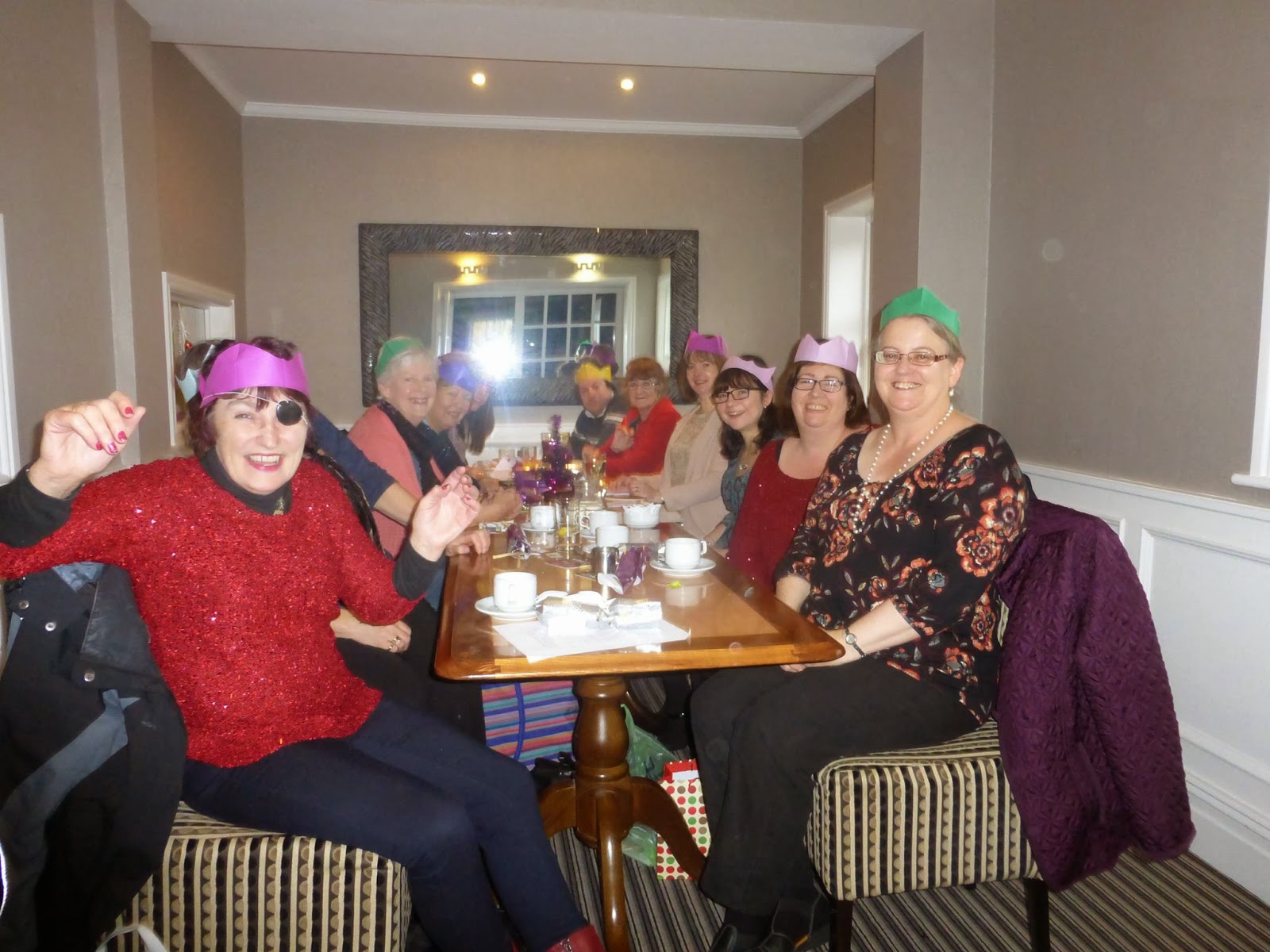
It started with the Christmas Ladies Brunch at Caradoc Mission, Seaforth, with lovely decorated tables, a buffet, lots of chat with my cousin Patsy, her daughter, Colette and friends, as well as jokes, a Christmas message and cupcakes and mince pies served at table.

On Thursday we had a Christmas social evening at Crosby Writers Club which was fun; Christmas readings, two quizzes and refreshments, including lovely mince pies baked by member, Joyce, to her special recipe. I read out my very first acceptance which was an article on Christmas Customs Around the World in 1983. I was paid a whole £25!

Then on the Friday there was the Novelistas Christmas lunch at the Bod Erw, St Asaph, with an exchange of writing news, a raffle in which everyone got a prize, and Christmas cake baked by Juliet Greenwood to her mother’s recipe which included the most tasty toasted almonds.

                                
             The Novelistas celebrating Christmas at Bod Erw, St Asaph.

When Saturday arrived it was St Paul’s church’s Christmas Fayre. I was in charge of the second-hand bookstall which is always interesting. Crime is always popular as are sagas. I picked up a copy of Maeve Binchy’s SCARLET FEATHER. But my favourite stall was the homemade cake stall. There were more lovely homemade mince pies, cup cakes and my friend Elsie’s bun loaf which was absolutely scrumptious. People chattered and worked together and it seemed to me that a good time was had by all and we raised a decent sum for the church. (The cost of heating is horrendous).

You might be getting the impression from what I’ve written so far that all I have on my mind is food. With four hungry males in the house that has some basis in face because I’m already planning what to eat for Christmas Eve, Christmas Day, New Year’s Eve and Day.

But on Saturday evening John and I attended a performance of Handel’s “Messiah” performed at Liverpool’s Anglican Cathedral by choirs from both Liverpool Cathedrals, accompanied by the Anglican Cathedral Chamber Orchestra. It was an experience not to be missed and was food for the soul. There was well over a thousand people in the audience and the performance was a real treat.

For lots of people Christmas is a time for family, although there are those who would do anything rather than spend time with their family. Too much pressure perhaps to play at happy families when the lead up to the day has been exhausting. I’m sure it was never meant to be like that and maybe it’s due to people seeing it only as a time for children and presents. Both can be a blessing but when expectations are too high, disappointment can follow. One of my sons has already said that he’s not doing presents this year and doesn’t want any either. He wouldn’t be the first. John and I decided a while ago not to give each other presents but settled on spending the money on two nights away in the Lake District before or after the Big Day. I can’t wait!

PART 20: FAMILY TIES

Despite what I said in my last blog about families and Christmas, my mother reared us in the belief that families should stick together. No doubt she saw the importance of doing so because her mother, Flora, died when Mam was only ten years old. Her aunts stepped into the breach to care for her and her siblings while her mariner father was at sea.

My parents, Stanley Nelson and May Lillian Milburn, married during the Depression in the Thirties and money was short. I remember Mam telling me how good my father’s mother, Ada Florence Nelson, nee Cooke, was to them, giving them tea and sugar and other food to help them out.

Since researching my ancestry, I know now that my grandmother Nelson, she also suffered the loss of her mother, Mary Ellen Gregory, at the same age as my mother did; although Mary Ellen was only thirty-one when she died and Mam’s mother was forty. Mary Ellen left a five year old daughter, Emma, as well as my ten year old grandmother.

 
Mary Ellen was born in Liverpool in 1854 and at seventeen was working as a general servant in Park Street, a long thoroughfare that ran from the docks up to Park Lane, a rather posh area of large houses in Toxteth in Victorian times. My mother also worked in service for a doctor and his family but that was in the 1920-30s.

Mary Ellen’s father, Stanley Gregory, was born in Aughton Street, Ormskirk, in 1821. But by 1845 he was living in Liverpool and that year he married Eleanor Nicholson from Anglesey, in the Church of our Lady, St Nicholas and St Anne. A bricklayer by trade, no doubt he had come to Liverpool like many another in search of work.

Stanley was one of fourteen children, including two sets of twins,(interestingly two of my Nelson cousins, Patsy and Audrey, gave birth to twins). His father, John, was also a bricklayer.

The Gregorys can be traced back to the reign of Queen Anne in the early 18th century living in the Ormskirk area. John had married a Moorcroft, as had his father, Robert, and there are several graves with the names of Moorcroft and Gregory to be found in the graveyard of Ormskirk ancient parish church, which is well worth a visit. The church is famous for having a spire and a tower and is open during the summer on market day.

       Ormskirk parish church in Lancashire: Photographer John Francis

Eleanor, whose mother was an Owen, was still living in Holyhead in 1841, so must have come to Liverpool between then and 1845. Her father, Jared, was a dock-gate man in Holyhead, so maybe one of his relatives was a mariner and married a woman from Liverpool and Eleanor visited them and that’s how she met Stanley. She had a couple of brothers and two sisters still living on the beautiful island of Anglesey.
                             My son Tim fishing at Trearddur Bay, Anglesey
                               Photographer: John Francis
                         Anglesey coastline with South Stack lighthouse in the distance.
                   

By 1851 Stanley and Eleanor were living in Clive Street, Toxteth Park. She was to die four years after her daughter, Mary Ellen’s marriage to James Cooke, the year my grandmother Ada Florence was born, but Stanley lived into the 1880s. So my grandmother must have known her grandfather, Stanley Gregory, and possibly some of her Welsh aunts and uncles, too. I always wondered why my dad was called Stanley and now I know.

It was whilst tracing the various Gregorys that two distant members of the Gregory family got in touch with me. I was interested in particular in Lavinia Gregory, who was the sister of my great-grandmother, Mary Ellen, being thirteen years younger.

I found Lavinia in the 1891 census living the other side of the Mersey in Birkenhead. She was a maid but later became a housekeeper and was to marry the master of the house. Although they married at a church in Toxteth, they settled on the Wirral. He already had children but Lavinia was also to provide him with more offspring.


                                My Great-great-aunt Lavinia's family home on the Wirral

       Family wedding at the house in the thirties. Lavinia is second left at the front.

Laura Holt (known as Pat) who emailed me the above photos got in touch with me from Australia. She is Lavinia’s granddaughter. Her mother and my grandmother, Ada Florence were first cousins. Lavinia did well for herself, brought up in a terraced house in Toxteth, went into service, eventually becoming a housekeeper and then the mistress of a large house, near Bromborough. Born in 1867, she lost her mother at the age of 9, but lived to the ripe old age of 85, dying in 1952, having seen the advent of the steamship, the motor car, the opening of the Mersey Tunnel and lived through two world wars.